Every business is its own. So is every problem.
The longer we do this, the clearer it gets: no two businesses run the same way, and software built for everyone rarely fits anyone exactly. That is why we believe in solutions built for the shape of your work. Below are a few of the problems we see most often across the businesses we help. We have been solving technical problems for nearly thirty years, and we would be glad to look at yours.
One system instead of five subscriptions
You pay one company for booking, another for your website, another for email, and a few more for everything in between. None of them talk to each other, and the bill goes up every year.
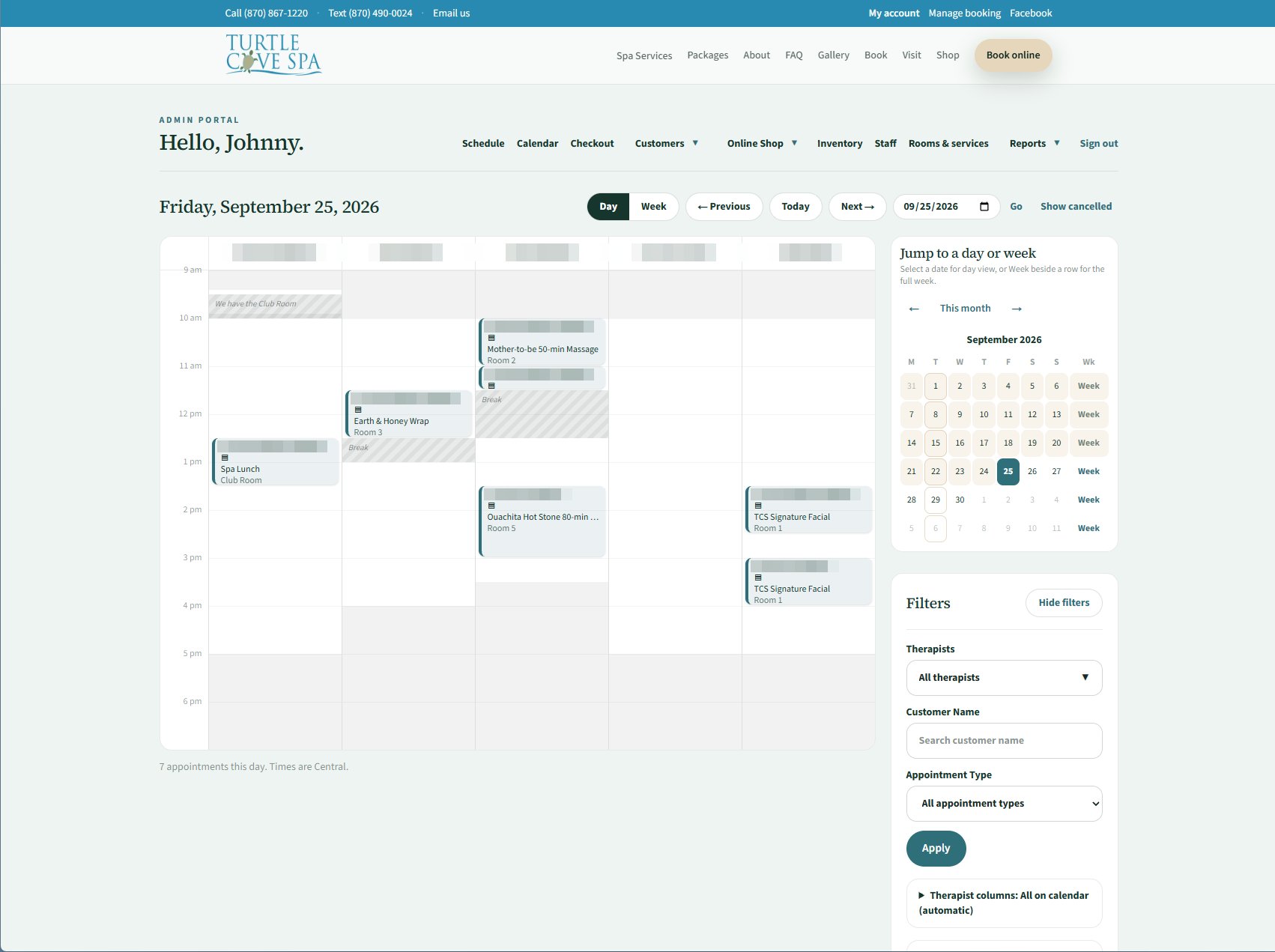
Turtle Cove Spa on Lake Ouachita was there. Booking and the front desk ran on subscription spa software. The website sat on a separate host behind a page builder, and changing one line meant three logins. Emailing their own guests was hard enough that it mostly didn't happen.
We replaced all of it with one system built around how the spa runs. Guests book on the spa's own website. The front desk checks out appointments, retail, and gift certificates on one screen. Confirmations and receipts go out by text and email. Staff schedules, payroll, inventory, the online shop, and the reports all live in the same place, and every client and visit came over from the old system.
It took about a week. The spa now pays hundreds a month less than it did for the tools it replaced.
You don't have to replace everything at once. Sometimes the first step is connecting two tools, and sometimes it's retiring the one that costs the most.
Now it's all connected to one whole website, the booking and the website all together. Being able to edit it all right there is going to be nice.
You probably need this if
- You pay three or more software companies to run one business
- Your website and your booking live in different places
- Somebody types the same customer into two systems
- Reports come out of one tool and get fixed in a spreadsheet
A direct to consumer booking app
Give the people who already love what you do a place that is all yours to book your time, buy your product, and come back for more.
A short term rental is the clearest example. Between the nightly stays there are hours that sit empty: an afternoon, a slow morning, the gap between one checkout and the next check in. Your own booking app can put those hours to work. A four hour block for a birthday party, a morning for a photo shoot, a weekday afternoon for a small workshop. These micro rentals slot in around the nightly Airbnb bookings and fill the gaps the listing sites were never built to sell, so the same property earns on hours that used to earn nothing.
An online retailer gets something just as good. Send your customers to one live page that is entirely yours, with real inventory counts updating as stock moves, click to purchase built right in, and your social feeds and comments woven into the same view. A follower who sees the post, checks what is left, and buys it can do the whole thing in one place, and the page keeps itself current without anyone touching it.
A salon or studio runs on the same idea. Clients pick their stylist, prepay or leave a deposit, add the treatment they want, and answer the intake questions ahead of time. When someone is due back, the app prompts the rebook and sends the reminder on its own, so the calendar stays full without the front desk chasing it.
Payments come built in when you want them. Cards, deposits, packages, and tips run through your own payment account and land straight in your bank. And if you still want the listing sites for reach, the calendar syncs both ways so nothing ever double books.
You probably need this if
- You have hours or products the big platforms have no slot to sell
- Customers keep asking to book or buy from you directly
- Somebody re-keys bookings between two systems
- You want live inventory, checkout, and social all in one place customers can act on
Data pipelines, dashboards, and daily summaries
Working with your data has become painful or fragile, and somebody spends part of every day carrying numbers from one system to another by hand.
If you're stuck manually populating spreadsheets, copying figures between systems, or rebuilding the same report every week, we can probably help. That work isn't analysis, it's plumbing, and plumbing should run on its own.
We automate the flow: nightly refreshes that pull from every source, land in one place, and feed dashboards that are ready to review when you sit down in the morning, with a daily summary if you'd rather read three sentences than open a screen. The post-level detail stays underneath, so when a number moves you can see exactly what moved it.
We've been doing this for over 20 years. Data pipelines, management, and presentation are one of our specialties, and it shows in the details: syncs that recover on their own when a source hiccups, numbers that reconcile instead of drifting, and history that doesn't vanish when a platform changes its API.
Below is a real dashboard we built and run, refreshing on live data as you read this.
You probably need this if
- The monthly report is assembled by hand
- Two people quote different numbers for the same month
- Nobody can say which post drove the spike
Media storage that knows what it has
Your photos and footage are scattered across drives, laptops, and old libraries, and nobody can find anything twice.
The problem isn't recording, it's what happens after. Two thousand clips named DJI_0416 lose track of which event they came from, the drive holding the only copy dies quietly, and finding last spring's footage means an afternoon of plugging things in and scrubbing thumbnails.
We build one home for all of it. Ingest takes whole folders at once and keeps what matters: the capture date, the location, the caption sidecars, all the things other tools strip out. Everything is organized and searchable by place, date, time of day, or type, so a typed phrase finds the clip instead of your memory doing it.
The automation runs on its own. Formats half the internet can't play get normalized on the way in while the master stays untouched, backups happen without anyone remembering to, and publishing pushes to YouTube with the title and description already filled in when you want it to.
Sharing is your call, item by item. Put a branded public gallery on your own domain, hand someone a ZIP of exactly the files they asked for, or keep the whole library private and visible to no one but you.
And it runs where you want it. Host it online on object storage priced like storage, or run it locally on your own hardware so nothing ever leaves the building. If you've already got a mess, bring the mess: point us at the drives and the old photo library, and we'll pull it into one place that knows what it has.
You probably need this if
- One external drive is the only copy of something
- Publishing a video takes more steps than making it
- Nobody can find footage from two years ago
A living archive that keeps the meaning
The files are already backed up. What is gone is the context: who is in the frame, why the house mattered, and which interview said it.
A documentary biography, a family shoebox, and a company that has been around thirty years all hit the same wall. Hours of interviews, photographs, deeds, and recordings survive on drives and in cloud folders, undated and unsearchable, until the people who knew what they meant are gone.
Genealogy sites give you a tree. A memoir gives you one authored voice. Cloud storage keeps the bytes. None of them hold lineage, narrative, media, and time pointed at each other in one place.
We build the archive that does. A private drop link with no account to create, so an eighty-year-old can hand over photographs without installing anything. Files land in storage that belongs to that archive alone. Interviews come back transcribed with a timecode on every sentence, so searching for a phrase lands on the second it was said instead of a file to scrub through.
The same shape works for a firm as for a family. Founder interviews, product milestones, why a non-standard material went into a bridge in 1998: none of that lives in the manual, and all of it walks out the door at retirement unless somebody holds it.
You probably need this if
- Fifty hours of interviews live on a drive and nobody can find a single sentence
- The meaning of a photo exists only in somebody's head
- You're producing a film or a book and the unused material has nowhere to go
- Institutional knowledge is about to retire with the person who holds it
A one-off app for one specific problem
Sometimes you don't need a platform. You need one small tool that does exactly one thing, and no product on the market does it.
Say you record long Loom walkthroughs and need each one sliced into chapters, automatically, without the video ever leaving your computer. That's not a product category, it's a Tuesday problem, and the usual answer is an hour of manual cutting or uploading confidential footage to some site you found.
We built exactly that tool: the Automatic Video Editor. Drop in a recording, paste your chapter timings, and it cuts one file per chapter right in the browser. The video is processed on your own machine, so it never uploads anywhere and there's no wait. It's live right now at editor.outlawapps.online, free to try.
That app shows the two ways a one-off can ship. Hosted, it lives on our platform at an address like that one, and you just use it. Branded, the same tool sits on your own domain with your name on it, styled to match the rest of your business, for your team or your customers.
The pattern goes well past video. A converter for the file format only your industry uses, a calculator that encodes how you actually quote jobs, a form that produces the exact document your county wants. If you can describe the one thing it has to do, it's usually a small build, and small builds are cheap.
You probably need this if
- One task eats an hour that a tool could do in seconds
- The workaround involves uploading private files to a stranger's website
- Every product that comes close does forty things you don't need and not the one you do
You started it. Now it has to hold up.
It works on your screen. Put a customer on it and it falls apart, and you already suspect as much.
Bring us what you've got. We run it and read the code, then tell you where it stands: the parts that hold up and the parts that have to be rebuilt before customers or money touch it. Then we do the work and hand it back, with the repository, the accounts, and the domain in your name.
Often the wall is the same: a weak login, keys sitting in the browser, a database that lets a stranger read every row, nothing backed up. The deploy has failed for a reason nobody can explain.
Sometimes what you built is fine and you need an afternoon of help. We'll tell you that too, and finding out costs the same either way.
The way in is a conversation, which costs nothing. Pick a time, bring what you have, and you leave knowing exactly what you have and what it needs.
You probably need this if
- Your API keys are somewhere in the front-end code
- Anyone who signs up can see everybody else's data
- There's no backup, and no one has tested restoring one
- You're afraid to change anything in case it all stops working
Tell us which one is yours.
Or describe the one we haven't listed. Telling us costs nothing, and once we've agreed what to build, $500 puts a working version of it in front of you.